What Is Considered Low Blood Pressure Reading?
Overview
What is depression claret pressure?
Hypotension, or low claret force per unit area, is when your blood pressure is much lower than expected. It can happen either as a condition on its own or as a symptom of a broad range of conditions. It may not cause symptoms, but when it does, it can crave medical attention.
Hypotension has two definitions:
- Absolute hypotension: Your resting claret force per unit area is below 90/60 mmHg (millimeters of mercury).
- Orthostatic hypotension: Your claret pressure drops within iii minutes of y'all continuing up from a sitting position. The drop must exist 20 mmHg or more for your systolic (top) pressure and x mmHg or more for your diastolic (bottom) pressure. Another name for this is postural hypotension because it happens with changes in posture.
Measuring blood pressure involves ii numbers, top and bottom, in mm/Hg.
- Systolic (top number): Your systolic pressure is the force per unit area on your arteries each fourth dimension your center beats. To find your systolic force per unit area, a healthcare provider* inflates a cuff that squeezes your arm. At the same time, they listen to your pulse at a point below the cuff. Your systolic pressure is when they can't hear your pulse anymore because the cuff's pressure is stronger than the pressure from your heart pumping.
- Diastolic (lesser number): That number is how much pressure your arteries are nether between heartbeats. The provider will keep listening for your pulse to discover your diastolic pressure while they deflate the gage. Your diastolic pressure is the number where they can again hear your heartbeat as the gage deflates.
*Thanks to technological advances, many modernistic devices can measure out your blood pressure automatically. These devices are now recommended for use instead of measuring blood pressure with the traditional stethoscope method.
What is the difference betwixt hypotension vs. hypertension?
Hypotension and hypertension are reverse conditions.
- Hypertension: The prefix "hyper-" means "too loftier."
- Hypotension: The prefix "hypo-" means "too low."
Who does information technology affect?
Hypotension can affect people of whatever age and background, depending on why information technology happens. Withal, it's more likely to cause symptoms in older people (especially orthostatic hypotension). Information technology tin can too happen with no symptoms to people who are very physically agile, which is more than common in younger people.
How common is this status?
Considering low blood pressure is mutual without any symptoms, it'southward incommunicable to know how many people it really affects overall. However, orthostatic hypertension seems to be more than and more mutual as you get older. An estimated 5% of people have it at age 50, while that figure climbs to more 30% in people over 70.
How does this condition touch my body?
Under normal circumstances, your torso can automatically control your blood pressure and keep it from dropping too much. If information technology starts to driblet, your body tries to recoup for that, either past speeding up your heart rate or constricting claret vessels to make them narrower. Symptoms of hypotension happen when your body can't compensate enough to offset the drib in blood pressure.
For many people, hypotension doesn't cause any symptoms. Many people don't even know their blood pressure level is low unless they get their blood pressure level measured.
For people with symptoms, the effects depend on why hypotension is happening, how fast information technology develops and what caused information technology. Slow decreases in claret pressure happen normally, so hypotension becomes more common as people get older. Fast decreases in blood pressure level can mean certain parts of your torso aren't getting enough blood flow. That tin take effects that are unpleasant, disruptive or even unsafe.
Symptoms and Causes
What are the symptoms?
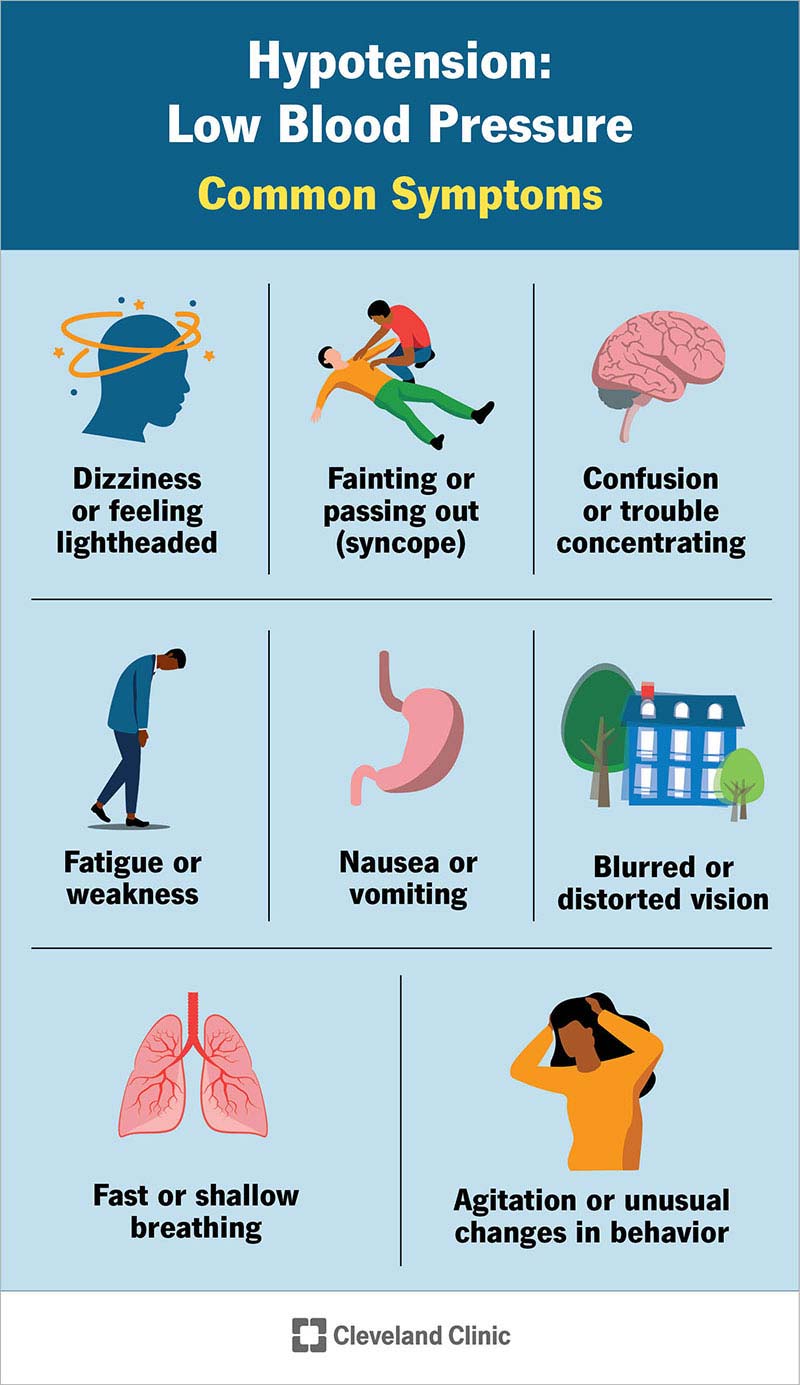
The most common symptoms of depression blood pressure level happen because your brain isn't getting plenty blood menstruum. These include:
- Dizziness or feeling empty-headed.
- Fainting or passing out (syncope).
- Nausea or airsickness.
- Blurred or distorted vision.
- Fast, shallow breathing.
- Fatigue or weakness.
- Feeling tired, sluggish or lethargic.
- Defoliation or trouble concentrating.
- Agitation or other unusual changes in beliefs (a person not acting like themselves).
What causes low blood pressure?
Hypotension can happen for a broad range of reasons.
- Orthostatic hypotension. This happens when you stand too chop-chop and your body can't compensate with more blood menstruation to your brain.
- Central nervous system diseases. Conditions similar Parkinson's affliction tin can impact how your nervous system controls your claret pressure. People who have hypotension because of these conditions may feel the effects of low blood pressure subsequently eating because their digestive system uses more than claret as it works to digest food.
- Low blood book. Claret loss from severe injuries can cause low claret pressure. Dehydration tin can also contribute to low claret volume.
- Life-threatening conditions. These weather condition include irregular heart rhythms (arrhythmias), pulmonary embolism, heart attacks and complanate lung. Life-threatening allergic reactions (anaphylaxis) or immune reactions to astringent infections (sepsis) tin can also cause hypotension.
- Middle and lung conditions. When your centre beats too fast or too slow, or if your lungs aren't working as they should, both can lead to hypotension.
- Prescription medications. Hypotension can happen with medications that treat blood pressure, eye failure, erectile dysfunction, neurological problems, depression and more.
- Alcohol or recreational drugs. Recreational drugs can lower your claret pressure level, equally can alcohol (alcohol's outcome only lasts a short time, and long-term overuse of booze tin cause high blood pressure). Though not technically medications, sure herbal supplements, vitamins or home remedies tin also lower your claret force per unit area, which is why you should always include these when you tell your healthcare provider what medications you're taking.
- Orthostatic hypotension is possible in the first and second trimesters of pregnancy. Haemorrhage or other complications of pregnancy can also cause low blood pressure.
- Extreme temperatures. Beingness too hot or also cold tin can affect hypotension and make its effects worse.
Is hypotension contagious?
No, hypotension isn't contagious, and so you can't get it from someone else or pass it to others.
Diagnosis and Tests
How is it diagnosed?
Hypotension itself is like shooting fish in a barrel to diagnose. All it takes is taking your blood force per unit area. Nevertheless, figuring out why you take hypotension is another story. If you have symptoms, a healthcare provider volition likely utilize a variety of tests to figure out why it's happening and if there's whatever danger to you because of it.
What tests will be done to diagnose this condition?
Tests that are likely with hypotension include those listed below.
Lab testing
Tests on your blood and urine can look for any potential issues like:
- Diabetes.
- Vitamin deficiencies.
- Thyroid or hormone problems
- Low fe levels (anemia).
- Pregnancy test (for anyone who can get pregnant).
Imaging
If doctors suspect a eye or lung problem behind your hypotension, they'll probable apply imaging tests to confirm or rule out those suspicions. These tests include:
- X-rays.
- Computed tomography (CT) scans.
- Magnetic resonance imaging (MRI).
- Echocardiogram or like ultrasound-based tests.
Diagnostic testing
These tests look for specific issues with your heart or other body systems.
- Electrocardiogram (ECG or EKG).
- Exercise stress testing (or some variation of that examination).
- Tilt table test (tin can help in diagnosing orthostatic hypotension).
Direction and Treatment
How is information technology treated, and can it be cured?
Treating hypotension unremarkably starts with finding out why it'southward happening. If that crusade is treatable directly, hypotension will usually become amend on its own. An case of this is hypotension that happens considering of an injury and blood loss. Repairing that injury and replacing the lost blood (such every bit with a blood transfusion) will stop hypotension as long as the repair to the injury holds. If you take medications that bear on your claret pressure, your healthcare provider may modify your dosage or accept you stop taking that medication entirely.
If the crusade remains a mystery, it'south also possible to care for it straight. However, curing hypotension is simply possible if there's an underlying cause that'due south curable.
What medications/treatments are used?
Treating hypotension direct usually happens in one of three ways:
- Increasing blood volume. This method, also known as fluid resuscitation, involves infusing fluids into your claret. Examples of this include intravenous (IV) fluids, plasma or blood transfusions.
- Making blood vessels constrict. Just every bit at that place are medications that lower your blood pressure past relaxing blood vessels in your body, there are also medications that take the opposite effect.
- Alter how your torso handles fluids. Your kidneys are responsible for maintaining the fluid balance in your body. Certain medications tin make your kidneys keep fluid and salt in your trunk, which tin can assistance with low blood pressure.
Complications/side effects of the treatment
The complications of either handling depend on the exact medication or treatment you receive. Your healthcare provider tin best explain the possible complications or side effects. That's considering they tin consider your specific circumstances, including other health conditions, medications you take and more than.
How to have care of myself?
If your healthcare provider diagnoses you with hypotension, they may practise the following:
- Advise you to change your diet. Increasing your salt intake can oft help increment your blood pressure.
- Teach you how to recognize and react to symptoms. A key way to help you lot avoid issues with hypotension is recognizing information technology. Your provider can help you recognize what low blood pressure level feels like and how to react.
How soon after treatment will I feel better?
Depending on the cause of your hypotension, you may experience better as y'all receive treatment. In some cases, information technology may take longer — days or even weeks — for medication or other treatments to help you experience better consistently.
Prevention
How can I reduce my risk of developing this or prevent it entirely?
It'southward commonly not possible to reduce your take a chance of or prevent hypotension. The only exception is avoiding circumstances or actions that can lead to it, such as taking recreational drugs or supplements/herbal remedies that can lower your blood pressure.
Outlook / Prognosis
What can I wait if I have this condition?
If you accept hypotension, what you lot can look depends on what causes information technology and if you lot have symptoms. If you don't have symptoms, it'south unlikely that hypotension will exist a trouble for you.
If y'all have symptoms, hypotension tin interfere with your ability to stand upward, care for yourself, melt, drive and do many other activities. That's why understanding the condition and following a healthcare provider's guidance are so important to minimizing this condition'south affect on your life.
How long does hypotension last?
How long this condition lasts depends very much on what caused it. If you have hypotension because of normal aging, it volition probably be a lifelong business organisation.
What's the outlook for hypotension?
If you have depression blood pressure but don't take symptoms, this status usually isn't harmful and shouldn't impact your life.
If you do have symptoms, the underlying crusade is commonly what determines the outlook for this condition. Your healthcare provider is the best person to tell y'all what to expect from this condition and what you can do to manage those furnishings.
Complications that can happen because of hypotension include:
- Falls and fall-related injury. These are the biggest run a risk with hypotension because it can cause dizziness and fainting. Falls can atomic number 82 to broken bones, concussions and other serious or even life-threatening injuries. If you have hypotension, preventing falls should be i of your biggest priorities.
- Shock. When your blood pressure level is low, that tin can bear on your organs by reducing the corporeality of blood they get. That tin can cause organ damage or fifty-fifty stupor (where your torso starts to shut down considering of limited claret flow and oxygen).
- Heart bug or stroke. Low blood force per unit area can cause your heart to try to compensate by pumping faster or harder. Over fourth dimension, that can cause permanent center harm and even heart failure. Information technology can besides cause problems like deep vein thrombosis and stroke because claret isn't flowing like it should, causing clots to form.
Living With
How do I take care of myself?
If yous accept hypotension with symptoms, the all-time thing you tin do is follow your healthcare provider'south guidance on managing this condition. Their recommendations may include whatever of the following:
- Manage your diet. Post-obit diet recommendations, specially how much table salt you should have in your diet, can help avoid symptoms of hypotension.
- Have your medication. These tin can help you avoid the disruptive symptoms and effects of this condition.
- Wearing apparel up. Pinch socks, which put light pressure on your legs and feet, tin button blood upward and raise your blood force per unit area.
- Take it slow. Avert standing up too quickly, especially with orthostatic hypotension. That tin can help y'all avoid the dizziness and fainting furnishings of hypotension.
- Accept a seat. If you notice yourself feeling dizzy or airheaded, sit down. Falling from standing height can put y'all at gamble for severe or even catastrophic injuries from a fall, such equally a broken hip, concussion, skull fracture or broken ribs.
When should I telephone call or see my healthcare provider?
If you lot know you take hypotension, you should see your healthcare provider if you start to notice symptoms affecting your life or disrupting your usual routine and activities. If you lot don't know yous have hypotension, you lot should see a healthcare provider if you have repeated dizziness or fainting episodes. This is especially of import because those symptoms are possible with many other health weather, some dangerous.
When should I go to ER?
If yous have hypotension, you should go to the infirmary for the following:
- Chest hurting (angina).
- If y'all pass out or faint.
- If you fall considering of lightheadedness and hit your head (particularly if you're taking whatever blood-thinning medications). You should likewise go to the hospital if you injure yourself considering of a fall from passing out.
- If you lot have any symptoms of shock, such as feeling cold, sweaty, breathing fast, or you have a fast center rate. You may likewise have a blue tint to the pare of your lips or under your fingernails.
A note from Cleveland Dispensary
Hypotension is a condition that can have no symptoms, and many people don't fifty-fifty know they accept it. For others, information technology can cause symptoms that are unpleasant and fifty-fifty confusing to your daily life and activities. If you suspect you lot have it, getting it diagnosed and treated is essential and tin aid you lot avoid falls and other complications. Fortunately, this condition is often treatable, and there are many things your healthcare provider can explain to you that can assist you intendance for yourself.
Source: https://my.clevelandclinic.org/health/diseases/21156-low-blood-pressure-hypotension
Postar um comentário for "What Is Considered Low Blood Pressure Reading?"