What Is the Name of the Cave Art Found in Cantabria
Ancient people may accept created cave art while hallucinating
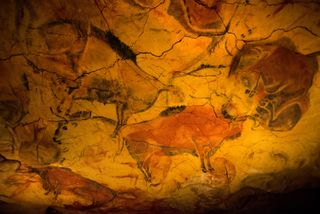
Stone age people may have deliberately ventured into oxygen-depleted caves to paint while having out-of-body experiences and hallucinations, according to a new study.
In the 19th century, researchers discovered a serial of decorated caves that engagement back betwixt 40,000 and 14,000 years — to the Upper Paleolithic era or tardily Rock Age — across Western Europe. The caves, found mainly in Spain and France, were filled with wall paintings, many of them in areas that could be accessed only through narrow passageways. The depictions were painted in blackness and red and primarily showed animals with some hand stencils, handprints and geometric abstract signs.
But why would people get through the trouble of walking through narrow cave passages to make art? To answer this question, a group of researchers at Tel Aviv University focused on a feature of such deep, narrow caves, specially those that require artificial calorie-free to navigate: low levels of oxygen.
Related: Senses and non-sense: seven odd hallucinations
The researchers ran computer simulations of model caves with different passageway lengths that atomic number 82 to slightly larger "hall" areas where paintings may be constitute and analyzed the changes in oxygen concentrations if a person was to stand in the different parts of the cavern burning a torch. Burn, such as that from torches, is one of several factors that depletes oxygen inside caves.
They found that oxygen concentration depended on the pinnacle of the passageways, with the shorter passageways having less oxygen. In most of the simulations, oxygen concentrations dropped from the natural atmosphere level of 21% to 18% after being inside the caves for only about xv minutes.
Such low levels of oxygen can induce hypoxia in the body, a status that can cause headache, shortness of breath, confusion and restlessness; but hypoxia also increases the hormone dopamine in the brain, which can sometimes lead to hallucinations and out-of-body experiences, according to the study. For caves with depression ceilings or small halls, the oxygen concentration dipped as depression as 11%, which would crusade the more severe symptoms of hypoxia.
The researchers hypothesize that ancient people crawled into these deep, nighttime spaces to induce altered states of consciousness.
"Hypoxia might well be a plausible caption for many of the depiction locations, which are far from the cave mouth and require passing through low, narrow passages," the authors wrote. "Nosotros contend that entering these deep, nighttime caves was a conscious choice, motivated by an understanding of the transformative nature of an cloak-and-dagger, oxygen-depleted space."
Caves had a special significance for these ancient civilizations. They were seen as "portals that connect to the underworld," pb author Yafit Kedar, a doctoral candidate in the Department of Archeology and Most Eastern Cultures at Tel Aviv University, told Alive Science in an electronic mail. The findings suggest that the ancient people sought altered states of consciousness and created cave depictions as "a way to maintain their connection with the entities" of the underworld.
There are some parts of the caves that were more than ventilated that too contained these depictions. However, altered states of consciousness "could be achieved in these contexts via other agencies than hypoxia," the authors wrote. What's more, the authors only simulated the outcome that torches take on oxygen in the caves, merely other parameters such as homo respiration or natural chemical reactions that take place in caves can fifty-fifty farther decrease oxygen concentration, they wrote.
The researchers now hope to analyze how many people could be together at the same time in these caves with limited amounts of oxygen and for how long.
The findings were published on March 31 in The Periodical of Archeology, Consciousness and Civilization.
Originally published on Live Science.
Source: https://www.livescience.com/upper-paleolithic-cave-art-oxygen-hallucinations.html

Postar um comentário for "What Is the Name of the Cave Art Found in Cantabria"